Two black teas grown in France! Kerizel and Mendiko
Two black teas grown in France!
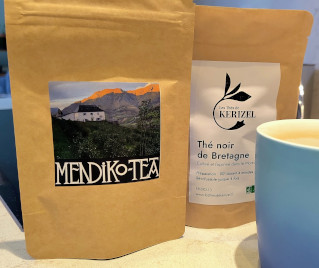
There are growing numbers of small tea farms appearing in Europe. There's some pre-history to this, but most of what I'm referring to is independent little initiatives trying it for the first time. I've written about Dutch-grown black tea earlier this year. And at Brussels Tea Festival I met people from two French farms, one in Brittany and one in Basque.
Here are my tasting notes. I only bought their black tea, since it's my main interest, but they're making others too. They are small producers - you buy very small batches of tea. It's high-quality, often intended for multiple infusions. Not cheap, of course. I drink it without milk or anything else, and that's probably the intention too. The general advice is to brew these for 3 or 4 minutes at 90 degrees, but you can try different ways to see what suits you best.
I'm going to say straightaway that I have a favourite out of these two, and it's the "Mendiko" from Basque country. I had the same impression when I tasted them at the tea festival, but I was super keen to try them both out at home:
Mendiko-Tea - tea grown in the Basque country
Nice-looking thin dark leaves. Strangely, they specify on the packet that it should be brewed for 3 minutes and 34 seconds! Are they having a laugh?? Anyway I did as I was told, with 90 degree water and 3g of tea in my mug. The resulting brew is light-coloured red, but really what strikes me at first is a gorgeous honeyed smell with a hint of biscuit - really appealing.
Drinking it, the honeyed flavour continues through, nice, with a medium body behind it. I didn't expect it to be very "hefty" like a strong black tea for a Brit, and indeed it's light, but it does fill the mouth. It's a great cuppa.
Second brew: the aroma is more muted, of course, but the flavour is still very present.
Third brew: doesn't taste of much. Fourth brew: the main flavour has gone, and what remains is pure watery with a slight lingering sweetness. You could well stop after two, but this tea exits gracefully!
Kerizel - tea grown in Brittany
Nice-looking thin black long leaves - very long and wiry. I brewed it for 4 minutes.
The tea has a nice solid red colour, and a lovely sweet golden smell. The taste is also nice and golden, on the front of the mouth. I miss a little the "heft" of anything dark or at the back of my mouth. I find this tea a bit more onedimensional than the Mendiko or the Zuyderblad - for me it's not as moreish.
The second infusion is viable, it's the same but a bit less pronounced - slightly more balanced, even! - but I don't get much from any further brews. Still, no astringency or anything like that on the exit, which is fine.
Glad I bought these packets. It's pretty rare to find tea grown so close to home, and I'm looking forward to seeing what else is out there.
Mrouzia - a decadent Moroccan tagine
I tasted this amazing vegan version of a Moroccan dish in Tangier (at the NBTA restaurant), and wow - such delicate flavours! I definitely had to make a note and then try to recreate it. I think I've done pretty well!
The finished dish should be a gloopy honeyed collection of lovely stewed objects, garnished with almonds and sesame seeds, and if you're feeling glam even some rose petals or orange blossom?
Mrouzia is traditionally made with lamb so you can choose whatever non-flavoured fake meat you like, ideally something a bit stew-friendly. I use some nice seitan pieces that come in a jar.
The spice mix is "ras-el-hanout" which basically indicates the classic Moroccan spice mix. There shouldn't be any chilli in it - that's not appropriate for this dish. We've had a couple of different ras-el-hanouts and some of them had chilli in.
Serves 2 people, takes 30 minutes.
- 160g seitan pieces - or other fake meat, in bite-size chunks
- 1 large handful almonds, maybe about 20 nuts (unsalted, whole or halved) (you could use pre-roasted almonds as a shortcut)
- 3 or 4 strands of saffron
- a stick of cinnamon (1 to 2 inches)
- 1 clove garlic, crushed, or an equivalent dollop of liquid garlic
- 1/2 tsp salt
- 1/2 tsp black pepper
- 2 tsp ras-el-hanout
- 25g butter or vegan butter
- 6 prunes (whole, but with no stones)
- 6 dried apricots (whole, but with no stones)
- 2 tbsp honey or vegan honey
- 2 tsp lemon juice (optional - I didn't use it but you may wish to use it to balance the flavour at the end)
- 1tsp sesame oil (toasted, e.g. the common Japanese sesame oil) (optional)
- 3 tsp sesame seeds
Bloom the saffron by adding it to half-a-cupful of hot water, five minutes before you use it.
In your stewing pan, add a splash of water and the butter. Turn the heat on so that the butter begins to melt while you also add the garlic, cinnamon stick, salt, pepper, ras-el-hanout, and the bloomed saffron with its water. Give it a simple stir to mix.
Add the fake meat, apricots and prunes. Bring it all up to a medium-hot heat and let it stew gently for ~30 minutes, with a lid on, until it's nicely reduced and there's not that much liquid left. Stir occasionally.
- Note: if you want to make this dish ahead of time, you can pause the recipe at this point e.g. take it off the heat. -
While the stew is cooking, prepare the almonds. If they aren't already halved, slice them lengthways. Then roast for 5-10 minutes in an oven at 180C (or a frying pan on a medium-to-low heat), and take them out again. Save a few of the almonds to garnish at the end, but add most of the roasted almonds to the pan, when there's maybe five or ten minutes cooking time left.
When the stewing time is done, and the stew quite well reduced, remove the cinnamon stick then add the honey and the sesame oil and stir. Let it warm/cook for a minute more. Check for seasoning (any lemon needed?).
Serve garnished with a generous sprinkle of sesame seeds over the top, as well as the reserved almonds.
Accompany it with bread or couscous.
Dutch-grown tea: Het Zuyderblad - tasting notes
Tea grown in the Netherlands! It's real! Earlier this month we visited Het Zuyderblad near Eindhoven. The tour was very informative (NB it was in Dutch). We encountered live tea plants for the first time, I think, and there was a nice cosy tasting session in their elegant converted barn space.
And here's the tea itself. In this case a black tea (I think they also produce a green): very high quality black tea, reminding me a little of Yunnan Hong cha (the golden taste is there, muted but confident).
Here are my home tasting notes:
I followed the instructions: a mug with 2 grams of tea, 100 C, 3 minutes. The tea has a good rich brown colour. The scent is a really clear "Maltesers" smell---which as Brits know means malty, sweet and chocolatey. The taste follows through on that: a lot like a "Yunnan gold" it's bright and malty, sweet, with just a touch of cocoa, while also rounded and medium-bodied. I like it - a satisfying single-origin black tea."
Second brew: 100 C, 8 minutes. malty but in a more gentle biscuity way. Good, though a touch thin for my taste, even though I gave it 8 minutes. It's fine to make a second brew from it but I might tweak the settings next time.
Third brew: I only did this as an experiment. Of course it's very thin, too thin for a normal drink, but what's noticeable is there's no astringent flavour at all (which I would usually get from over-brewing a black).
Availability: it's NOT EASY to get hold of this tea. I don't think they currently produce enough to sell it regularly. You might need to go to one of their tea tours.
Dan's guide to common birds of Morocco
Morocco has a nice set of birds - fun to encounter, for a European. Easy to get to know them even in the cities. Here's my hit list:
-
Moussier's redstart - This comes top of the list because
(a) it's the national bird of Morocco!
(b) it's endemic to the Atlas mountains - you only find it there!
(c) we saw it foraging around while we stopped at the top of a mountain pass for a glass of mint tea! (The mint tea was for us. I don't know what the bird had.)
(d) I took a classic photo of it. Can you see the Moussier's redstart? With its black-white-black-white upper pattern, and underneath its rust-red belly?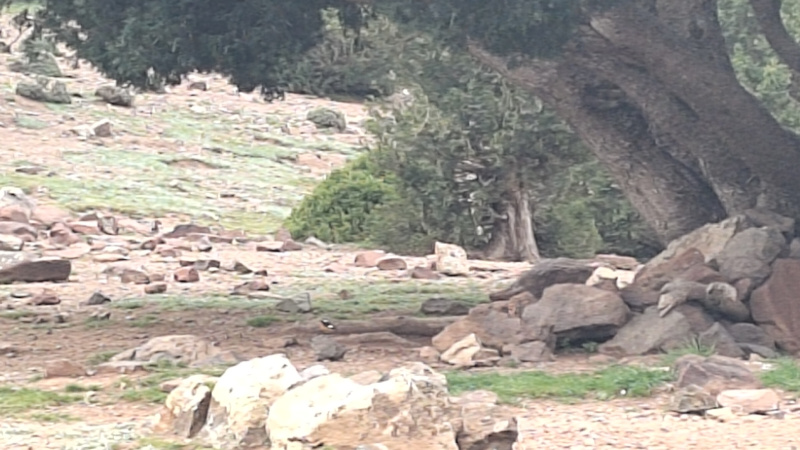
-
Spotless starling. This looks similar to our familiar starling but is pure black instead of iridescent. It sings differently. And it waggles its wings in an endearing way while it sings. ... You have to see it in action.
-
Alpine swift. These high-speed birds I've seen elsewhere, but the novelty is that there are many of them racing around in the city squares of Morocco, nesting in holes in the wall and then racing around flying low and screaming enthusiastically as they race past you in groups diving for insects.
-
House bunting. This little bird is noticeable for its all-grey head and its all-brown body, which really is a different colour-scheme than most birds you'll see around. It's common in north-west Africa and so I guess Morocco is a good plac to see them. We often saw them living/foraging actually inside riads, and elsewhere.
-
Common bulbul. The bulbul I've not seen before, but it's apparently common all across Africa. It was common in cities, with a pale brown topside and a white underside.
-
White stork. The stork is pretty common where I come from but in southern Spain and northern Morocco there were many. What's especially noticeable about storks is their massive nests, which they build right at the top of mobile phone masts or disused mosque minarets, making intriguing architectural intervensions.
Morocco street food
Morocco's street food gave me a lot to discover! Whether from a stall, or from someone pushing a hand-cart through the busy medina (market), I was surprised how many tasty things were commonplace there, and new to me. Here are some of my favourites:
- "Kalinti". It's a chickpea-flour-cake as a savoury snack - imagine it as a kind of vegan omelette, because that's pretty much the texture. Many times in northern Morocco we saw this really popular street-food being sold. The kalinti is served in a bread roll (like a short baguette), always accompanied by spread cheese, plus sauces and other toppings such as gherkins or meat. It's a strange combination, I think - the smooshy texture of kalinti with the smooshy texture of spread cheese?! - but it's a hearty snack, and very popular in northern Morocco! A full tin of kalinti, e.g. a round dish about 60 cm diameter, would easily sell out in ten minutes.
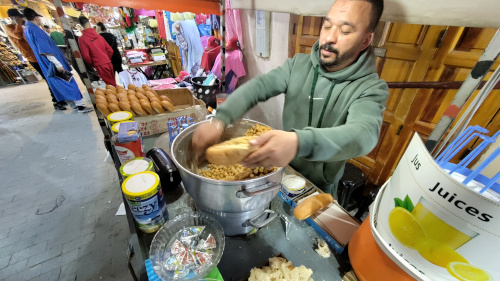
- Chick-peas. At various places in Morocco I saw a seller with a hand-cart, selling cooked chick-peas (presumably fried with a bit of spice). You could buy a simple paper cone of chickpeas to nibble on, or alternatively a sandwich like the above kalinte, i.e. with spread cheese alongside the chickpeas. I didn't see kalinti in Marrakech, but I did see this one.
- Bissara - a simple and hearty split-pea soup. Specialist stalls/shops simply sell this one dish, served with bread and olives. Really good value and a good meal.
And the sweet snacks:
- "Briwate" or "briouate" are samosa-like triangles, and they can be savoury or sweet. Since I avoided the meat, the sweet ones were most interesting, e.g. filled with dates, sultanas and almond paste. My favourite was, I think, a one-off: in Fes, a briouate filled with rice and sweetened with honey/syrup. A delicious hybrid of samosa, rice pudding and caramel flavours!
- There were many pastries, and many pastry stalls stacked SO HIGH with pastries! A favourite that I hadn't seen before was the "gazelle's horn": a crescent-shaped little sweet pasty, stuffed with rich moist almond paste.
Also juices! So many fruit juices! Many stands were simply operated by one person with a pile of fruit and a manual squeezer, which is a good thing to look for since you can guarantee the juice is freshly-squeezed and unadulterated. Some great combos that we had are peach and lemon, avocado and date (with some milk in this one, we think), and sugarcane with lemon. Simply sugarcane, crushed with a bit of added lemon, is surprisingly delicious!
I almost forgot to mention one of my favourite juices: pure pomegranate juice -- multiple times there was a stall which was simply a man with a pile of pomegranates, and a juicer. (OK, also a little tea strainer and some plastic cups.) Pomegranates are expensive, where I come from, because they don't grow where we are - so it's impressive that for an OK price he'll squeeze 3 pomegranates straight into a cup for you. The sweet-sour pomegranate juice is so great on a hot day.
--
And I want to mention a couple of things that aren't street food, but
- Zaalouk - a cold cooked aubergine salad - again a good dish for a hot day. It's really quite simple.
- Msemmen - square pancakes, with a flaky bready texture. We already know these back home, but they're very Moroccan. For breakfast we often had these with Moroccan cheese and honey
- Mrouzia - ordinarily this would be a lamb tagine dish, but I had a vegetarian creation at NBTA in Tangiers and it really was my stand-out dish of the entire trip. The taste is sweet and dark, thanks to the honey and prunces, then there's ras el hanout, roasted almonds, and sesame seeds all over. Such delicate and complex flavours, that you don't often get in a fake-meat dish. Fabulous. Go to NBTA in Tangiers.
Nisk: Kurdish lentil soup from northern Iraq
This Kurdish lentil soup is lovely and smooth. Simple but nicely balanced. A handful of rice balances the lentil flavour nicely and the whole thing becomes very smooth (even without blending it).
Thanks to the Asylum seekers' and Refugees Support Group, Nelson, UK, for writing this down, and thanks to the Kurdish woman whose name I don't know, for passing this recipe on!
Makes 6--8 servings, takes 45 minutes.
- 400g lentils (split red lentils, my mum uses - I don't know what's standard)
- 1/2 tsp turmeric
- 1 stock cube
- handful (e.g. 100g) basmati rice
- sunflower oil
- 1/2 tsp crushed chillis
- 1 onion chopped fine
- pinch of salt
Wash the lentils in warm water, then rinse them in cold. Put in a pan with ~4cm of cold water over them, cover, bring to boil.
Once the lentils boil turn the heat down, skim off the scummy bits - no need to be precise, doesn't matter if some remains. Do this while in parallel you start the next step of cooking the onions. (Maybe this means cooking the lentils for 10-15 minutes or so?)
Chop the onions finely and fry in a frying pan with the oil, on a medium heat, until starting to brown.
Tip the onions and oil into the lentil pan, plus 1 mug cold water or more (a pint?). Add salt, chilli, turmeric, rice.
Gently simmer for about 30 to 45 minutes - so that it is the right soupy consistency you want! If you need to add more water as it gently summers, do so.
Fennel and lemon tagliatelle
Oven-roasted fennel is great - it's roasty, and yet still fresh and fragrant. This simple dish makes the most of it. We made this in 2019 and remembered it today! And it's as lovely as it is easy.
Serves 2. Takes 35 minutes.
- 1 bulb of fennel
- 1 packet (250g) of …
Persian-inspired cranberry pilaf
Did you know that cranberries and rice are the 2 crops that can be grown on fully-saturated (i.e. damp) land? I learnt that this week from a colleague who studies how Dutch "polder" land can be farmed to absorb the most carbon.
So I decided to try making a …
Live music of the year 2025
I've seen some great music played at some ace festivals this year. Here are my highlights!
-
YoungRubbi - a punk/rap kid from Rotterdam, whose energetic, angry but inclusive live set that was everything you need! The circle-pit was full of people of all ages. Here's a highlights video you should …
My academic travel carbon footprint: Trains versus planes
I've been doing a lot of academic travel recently: conferences, project meetings, workshops, PhD exams. Luckily, I've been able to do almost all of it by train, even though I've been to more countries than I can easily count!
Here I want to list these and make an approximate carbon …